Visual
More than a year's hotel tax, still unspent
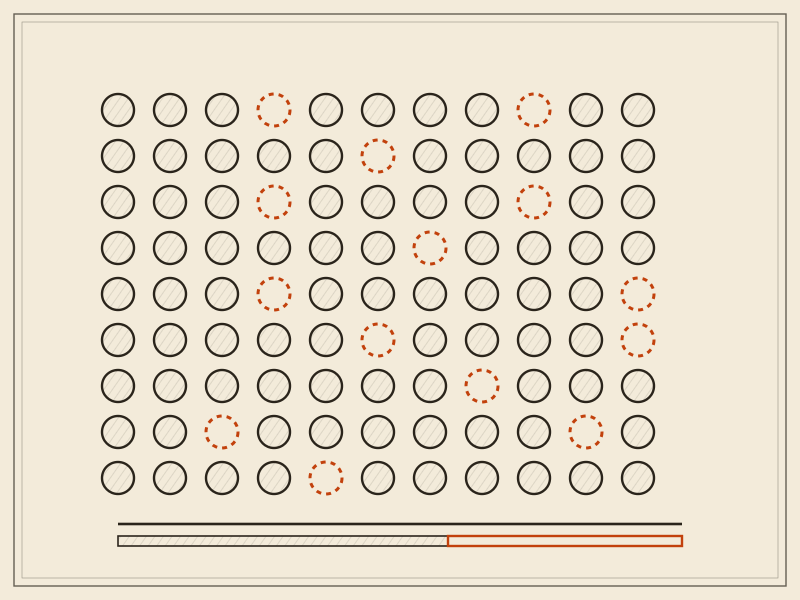
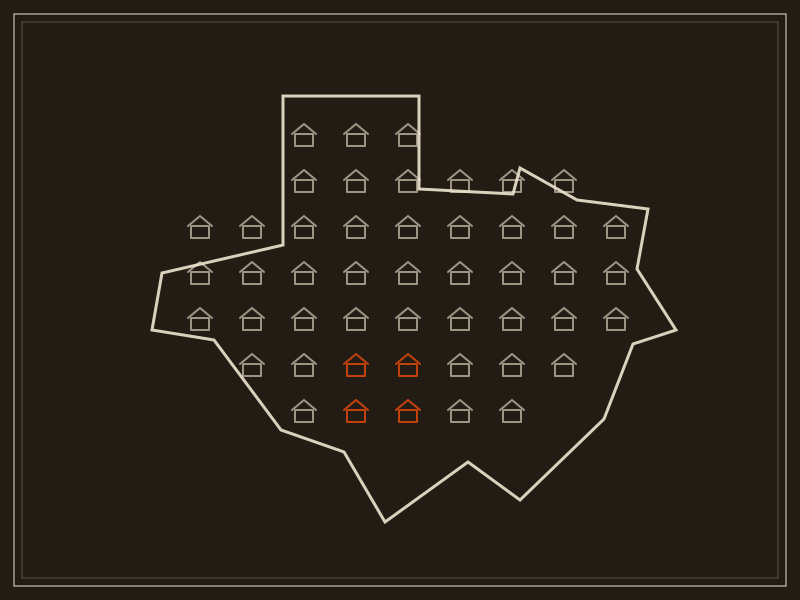
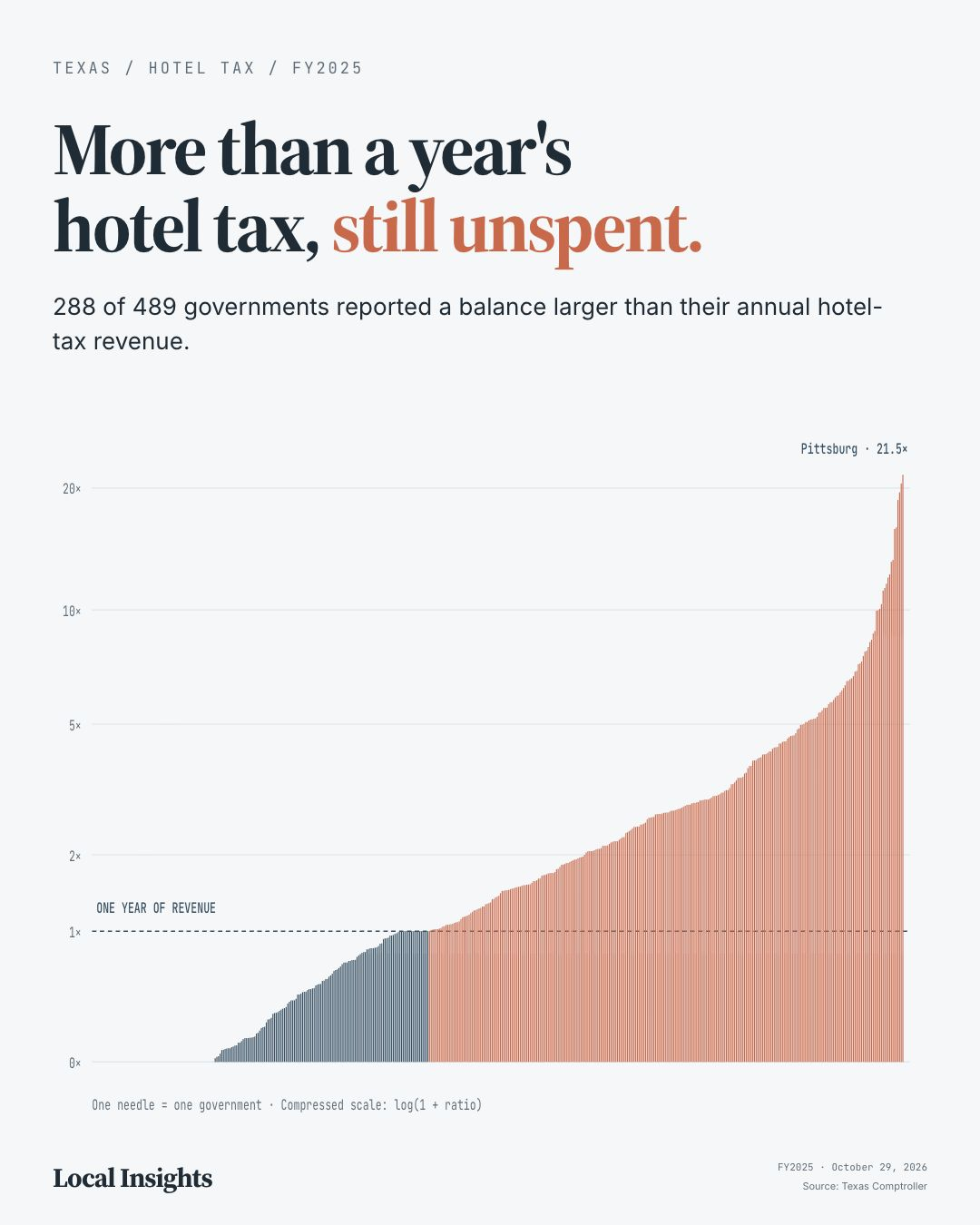
288 of 489 governments reported balances above their annual hotel-tax revenue.
ExploreVisual reporting on Texas civic life. Find a question, see why it matters, and follow the evidence.
Historical first-publication dates are not yet reconciled. Undated pieces retain the established collection order; source and update dates are labelled separately.
42 pieces
Visual
288 of 489 governments reported balances above their annual hotel-tax revenue.
ExploreVisual
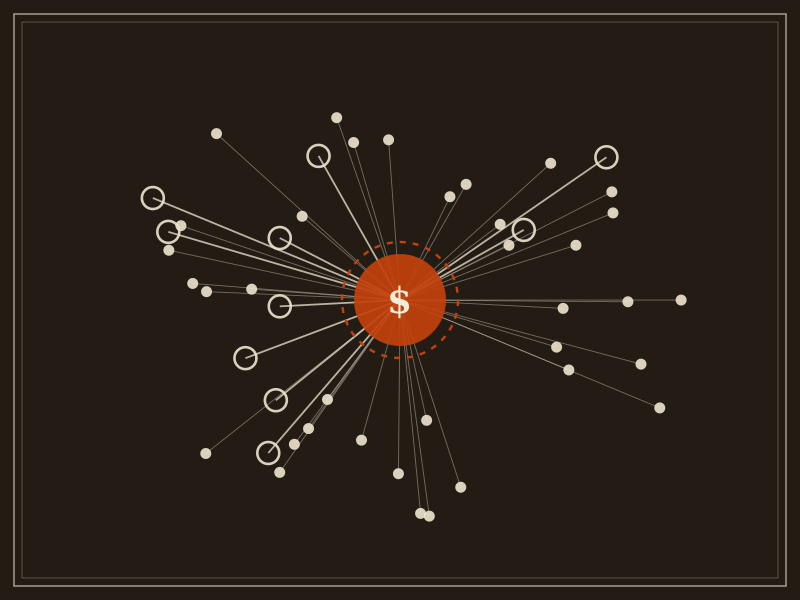
Ten named prime contractors account for $22.81 billion in original awards through 117 of the dataset’s 3,294 contracts.
Explore#230 · Visual
A sector with 15% of Texas jobs supplied 45% of its net annual job gain.
Explore#229 · Visual
More than half of people in TDCJ custody had reached their parole eligibility date.
Eligibility is not release approval.
Explore#228 · Visual
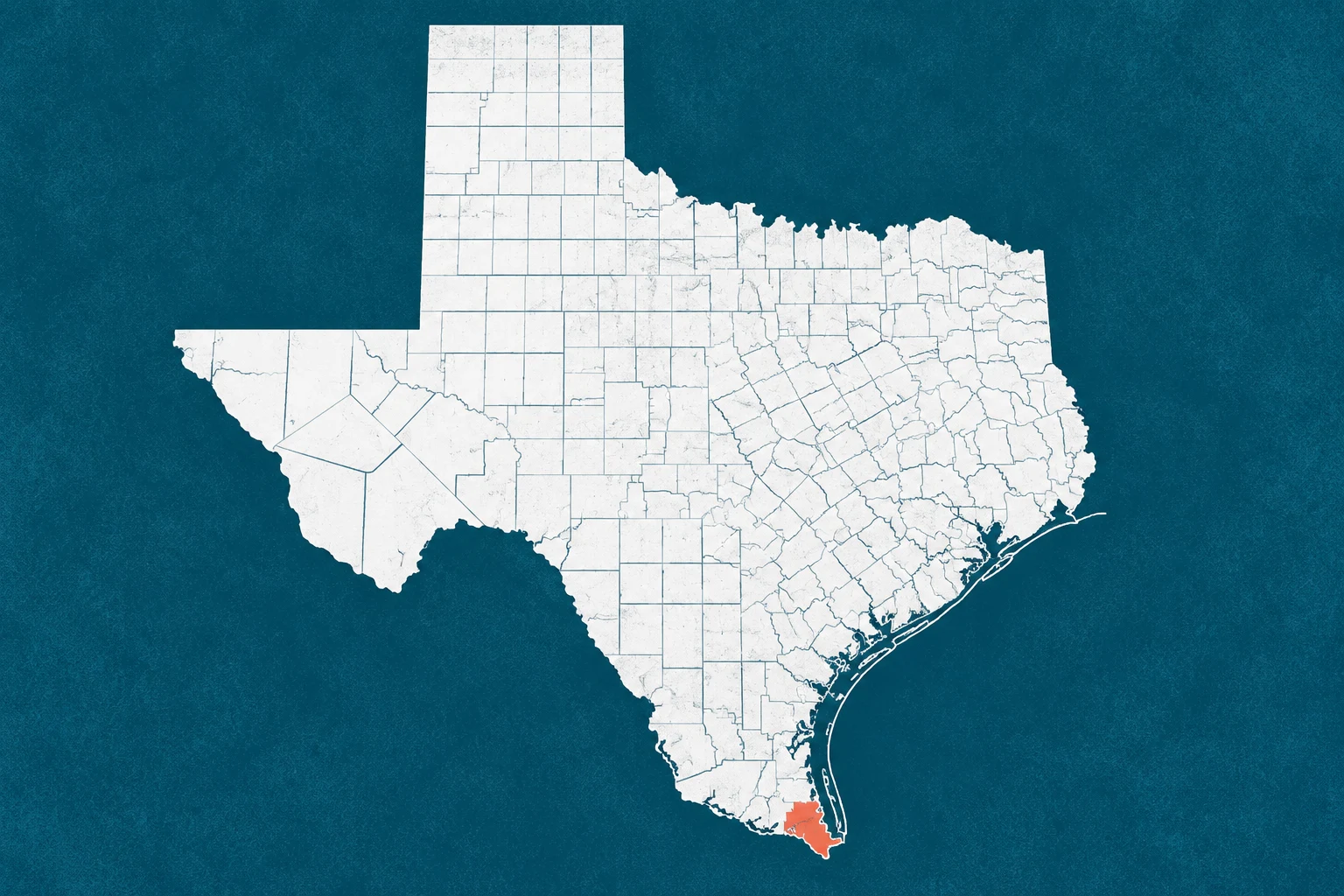
Cameron County: 22 nonrenewals per 1,000 policies, versus 5.0 statewide.
First reporting months; indicative rather than an annual rate.
Explore#227 · Visual
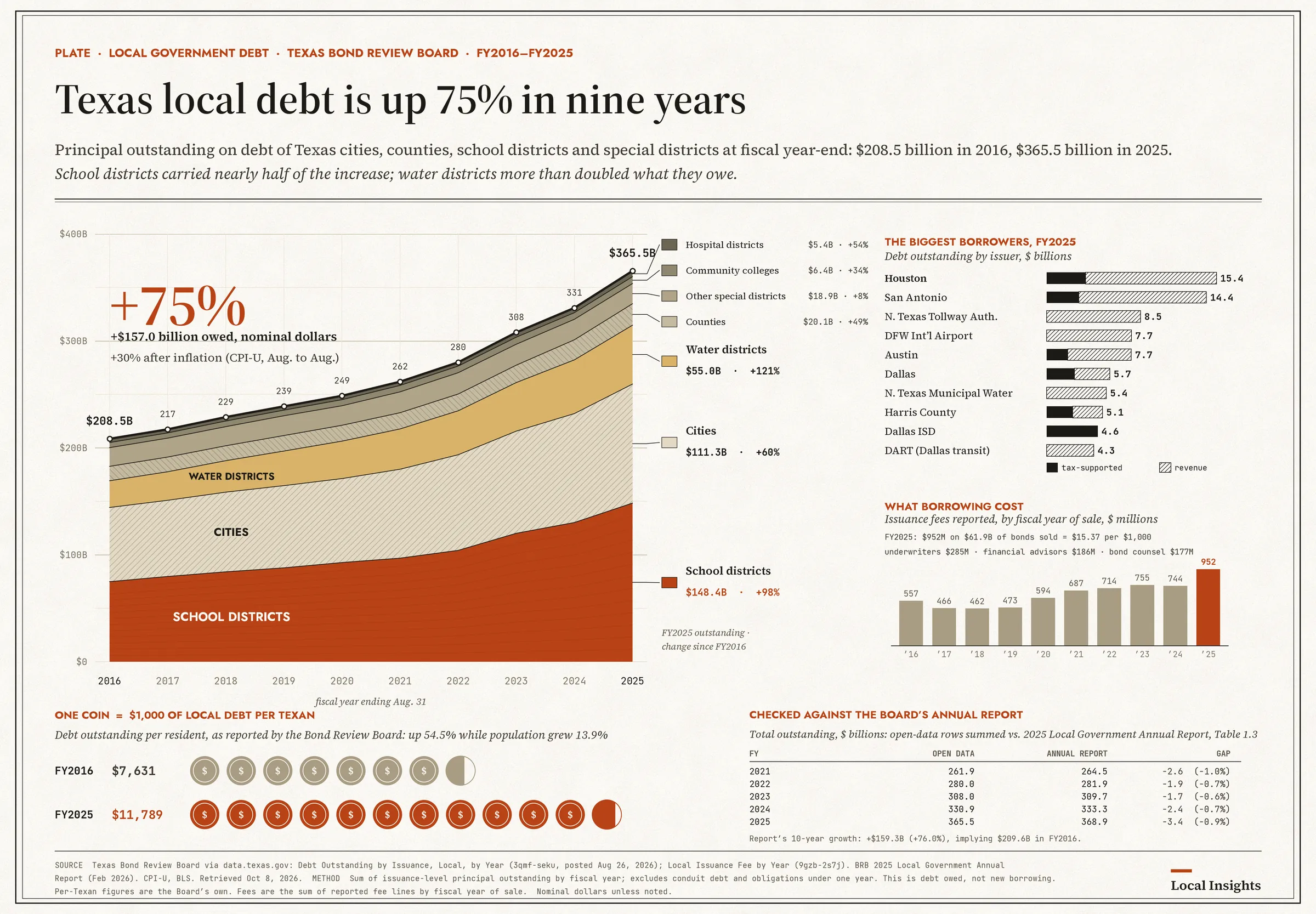
A rising balance is not the same thing as a year of new borrowing. School districts, cities, and water districts account for most of the increase, and Houston’s $15.4 billion is mostly revenue debt.
Explore#226 · Visual
A transmission plan becomes a route across somebody’s land. Texans need to see which routes have legal approval, what local governments have actually adopted, and what remains unresolved before equating a planning decision with construction.
Explore#225 · Visual
An Attorney General letter ruling can determine whether a requester receives all, some, or none of the government records sought. Texans deserve to see the system’s aggregate outcomes, its uncertainty, and the underlying data.
Explore#224 · Visual
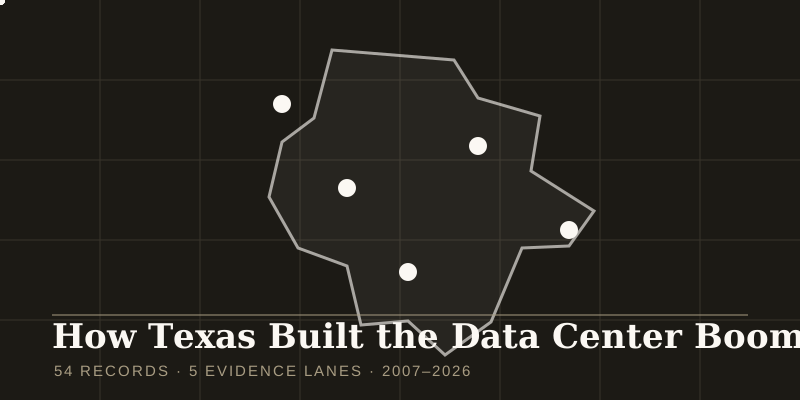
The boom is a sequence of public decisions, not a market accident. Seeing those decisions together changes the accountability debate from anecdotes to evidence.
Explore#223 · Visual
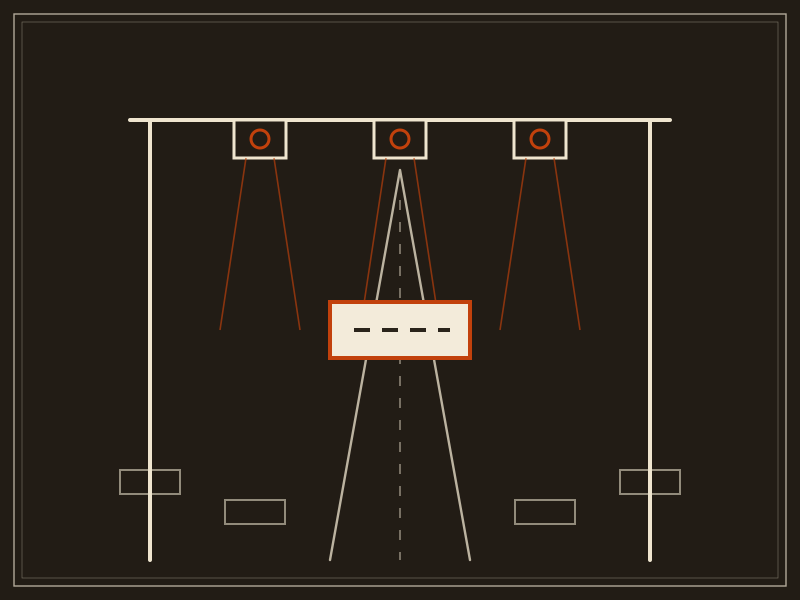
These cameras photograph every passing vehicle, not just suspects, and the networks are shared. Texas has no state law setting who may look, why, or for how long — HB 961 and HB 2083 both died in committee in March 2025. Every rule is set city by city, and most cities have set none.
Explore#222 · Visual
A residence homestead is a person-only tax break. When companies keep it — or keep a senior exemption no company can hold — the burden quietly shifts to the homeowners who qualify. No statewide system catches it.
Explore#221 · Visual
Campaign money shapes who runs, who wins, and whose calls get returned. When 250 donors supply half of all the money in a state of 31 million people, voters deserve to see the ledger.
Explore#220 · Visual
Commissioners Court votes on vendor contracts nearly every other Tuesday. When the same donors fund commissioner campaigns and hold county contracts, the public should be able to see the overlap in one picture.
Explore#219 · Visual
Every exemption a claimant can't legally hold shifts the tax burden onto the homeowners who can. Texas runs 254 county appraisal districts that don't share data, so nothing flags one owner claiming the residents-only break in several at once.
Explore#218 · Visual
Mixed-beverage receipts are a proxy for main-street vitality — bars, restaurants, and live-music rooms. A single-venue county sitting at zero for years running is a small town losing its last gathering place, invisible inside a record statewide total.
Explore#215 · Visual
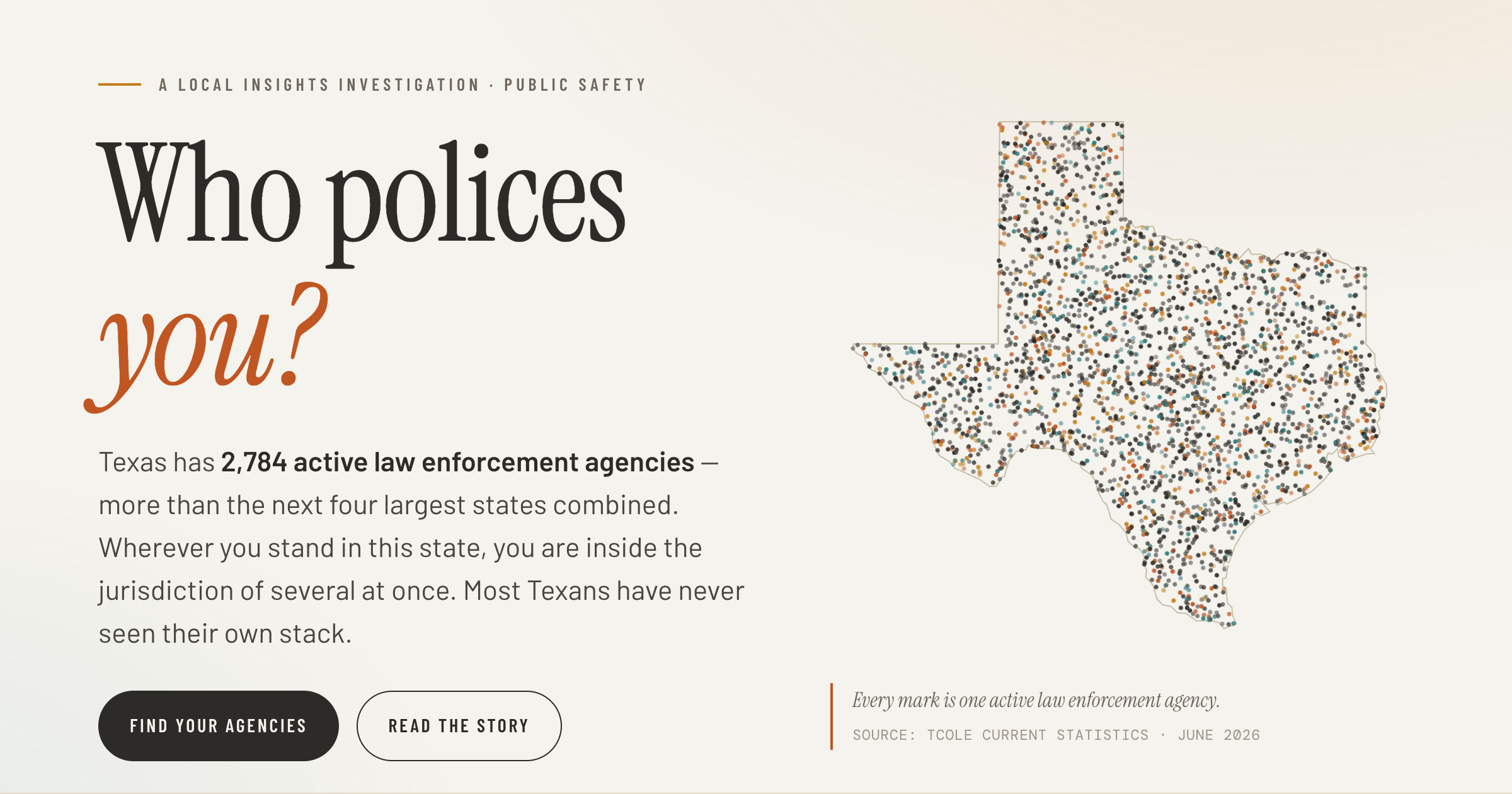
The Legislature is actively weighing whether to raise the bar for creating police agencies or encourage consolidation, with recommendations due to the 90th Session in January 2027. Texans deserve to see the system being debated — starting with their own address.
Explore#214 · Visual
Superintendents are the highest-paid public employees in most Texas communities. When their compensation bears no relationship to student outcomes, taxpayers deserve to see the data.
ExploreVisual
Texas appraisal districts operate county by county. When an entity retains a person-only homestead or senior exemption after a deed transfer, no statewide system automatically surfaces the error or shows residents which taxing units absorb the loss.
ExploreVisual
The budget passed with no property tax increase — but the shortfall didn't vanish. It moved onto the water/sewer utility and a new fee on ~400,000 households, while the five-year forecast still shows gaps. Residents deserve the mechanics, not just the headline.
ExploreVisual
Most residents believe one city governs them. In reality a stack of special districts levies taxes and carries bonded debt that a handful of voters approved. Making that stack — and the debt-per-vote behind it — legible is the first step to holding it accountable.
ExploreVisual
WARN filings are one of the clearest public signals of local economic stress. Residents, journalists, workforce boards, and local officials need to see where layoffs are hitting before the impact shows up in lagging indicators.
ExploreVisual
The O'Donnell consent decree reshaped how Harris County sets bail for misdemeanor defendants. This investigation surfaces defendants who cycled through the system — accumulating active cases while facing new violent charges — making the court data visible as geography.
ExploreVisual
Transparency without accessibility is meaningless. Ellis's financial relationships were buried across thousands of scanned pages and a 960MB state database. This tool extracts, connects, and makes them searchable — so citizens can decide what it means.
ExploreVisual
Municipal procurement processes were designed for an era when document review was expensive and time-consuming. AI-augmented citizen investigation changes that calculus. This case demonstrates what one concerned citizen can accomplish with public records and modern tools.
ExploreVisual
Public pensions are promises made to teachers, firefighters, police officers, and state employees. When those promises are underfunded by $107 billion, someone pays — either retirees through benefit cuts or taxpayers through emergency contributions. This build makes the math visible.
ExploreVisual
Pension data is typically buried in hundreds of pages of actuarial reports. This grid makes it possible to compare all 99 plans side-by-side in seconds, identifying which are recovering and which are deteriorating.
ExploreVisual
Most residents have no idea what's being decided in the meetings that affect their neighborhood. This dashboard closes the awareness gap by filtering agendas to your specific jurisdictions.
ExploreVisual
The calendar kill is the most powerful tool in Texas politics that most citizens have never heard of. Understanding which bills die this way reveals who really controls the legislative agenda.
ExploreVisual
Public parks are irreplaceable civic assets. Transparent tracking of development pressures helps communities defend shared spaces.
ExploreVisual
Harris County processes more criminal cases than most U.S. states. The difference between who goes home tonight and who sits in jail waiting for trial often comes down to the bond amount set — not the severity of the charge. This data has always been public. Now it's legible.
ExploreVisual
Appellate courts are where legal precedent is set. When they're backlogged, justice is delayed for everyone. Understanding capacity gaps helps prioritize judicial reform.
ExploreVisual
Energy policy shapes the Texas economy. Tracking interconnection queues, drilling permits, and enforcement patterns reveals where investment is flowing and where regulatory risk is emerging.
ExploreVisual
Water safety is non-negotiable. Transparent monitoring helps residents and regulators ensure safe drinking water.
ExploreVisual
Public sentiment shapes political capital. Understanding which issues are heating up across regions helps anticipate political dynamics before polls catch up.
ExploreVisual
Cities that merely comply with the law get a C, not an A. Residents deserve to know which cities are leading and which are coasting.
ExploreVisual
When FEMA redraws a flood zone boundary, it changes what homeowners pay for insurance, what their property is worth, and whether they can get a mortgage. These decisions happen quietly and affect millions — but most residents only find out when the bill arrives.
ExploreVisual
Special districts control billions in public debt and set tax rates that directly affect homeowners. Without transparency tools, residents have no practical way to evaluate their performance.
ExploreVisual
$4.89 billion in property value receiving tax incentives in a single county. The public loses an estimated $120M+ per year in uncollected revenue — while many of these properties charge market-rate rents.
ExploreVisual
Most Texans have never filed a public records request — not because they lack the right, but because the process feels opaque. This tool makes it as easy as filling out a form.
ExploreVisual
The real housing story isn't institutional investors — it's the 16% of homes held by small investor LLCs that nobody talks about.
ExploreVisual
San Antonio stands out at 8.6% institutional — nearly 3× the Texas average. Fort Worth has the highest small-investor concentration at 23.7%. Austin at 0.5% institutional is an outlier in the other direction.
ExploreTry a topic, a public body, or a different word from the story.